



Renforcer la collaboration homme-robot
Workshop Summary
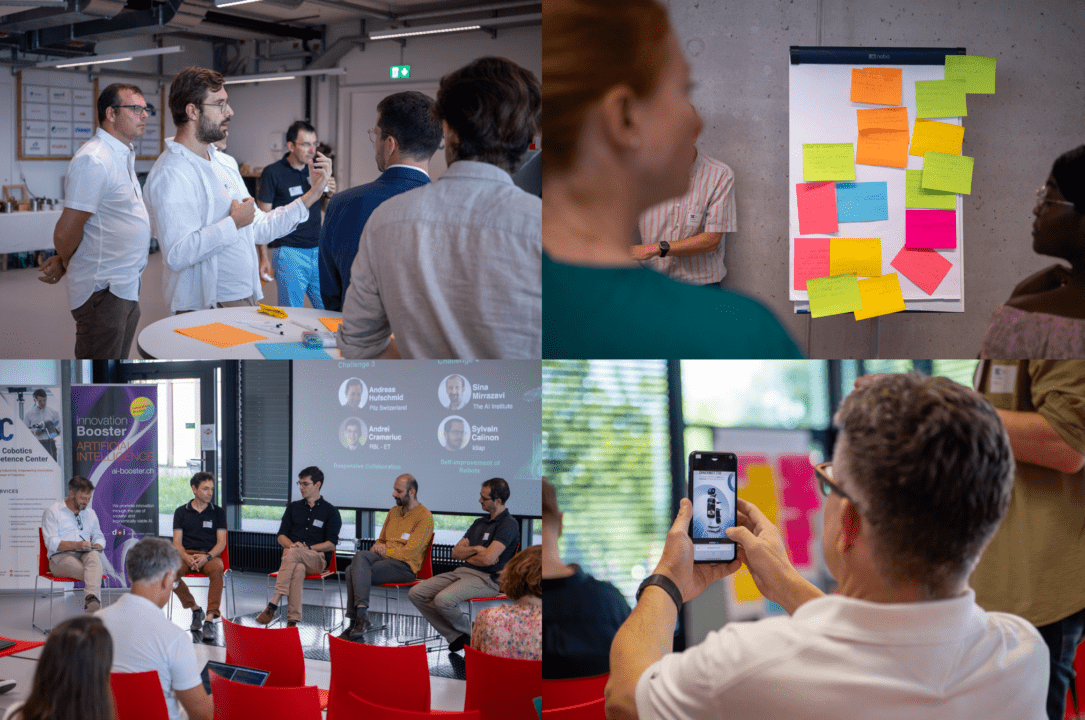
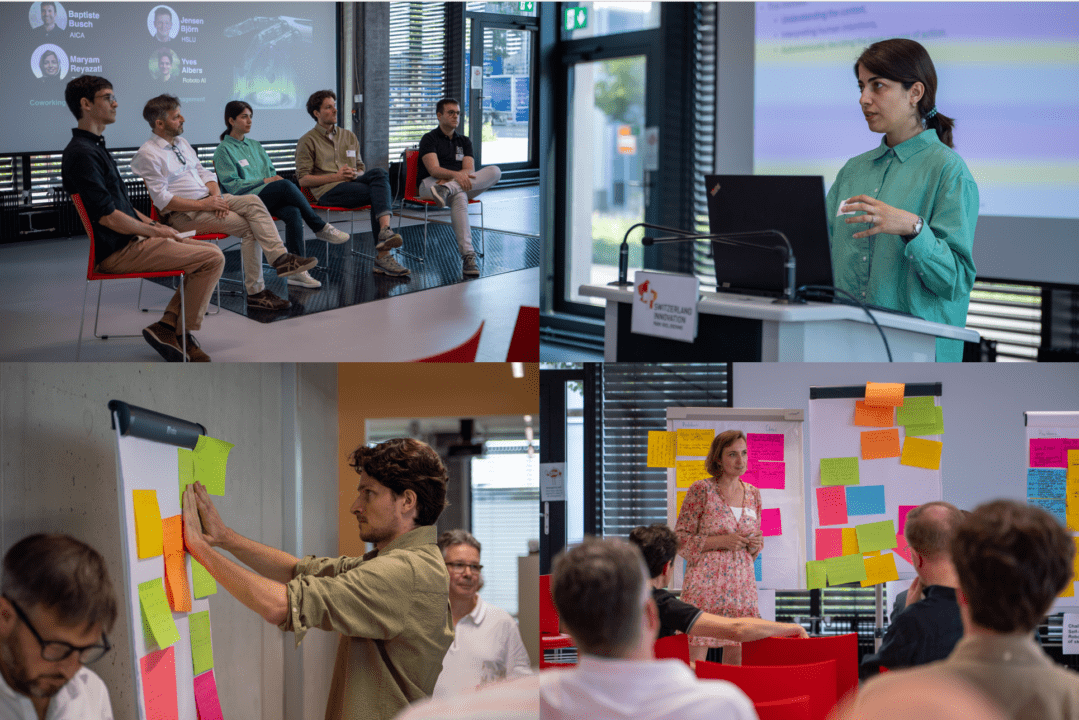
The Workshop on Empowering Human-Robot Collaboration, held on August 29th at the Swiss Cobotics Competence Center (S3C) in Biel, brought together industry professionals, researchers, and robotics enthusiasts. Through keynotes, case studies, panel discussions, and breakout sessions, participants explored challenges and proposed solutions related to data management in robotics. The day was structured into four thematic challenges—Co-Working and Learning, Data Management, Responsible Collaboration, and Self-Improvement of Robots—with discussions culminating in actionable ideas for future projects.
Needs/Challenges Identified
- Co-Working and Learning:
- Limited adoption of collaborative robots in industry due to safety, liability, and regulatory concerns.
- Difficulty in transitioning research advancements to practical industrial applications.
- Variability in human behavior complicates human-robot interaction, requiring advanced data retrieval and analysis.
- Challenges in adapting reinforcement learning to real-world environments.
- Data Management:
- Managing and processing large-scale datasets is resource-intensive.
- Lack of publicly available datasets for training robots.
- Challenges in developing generalizable data models for sensory processing and perception.
- Complexity in integrating regulatory compliance with data analytics.
- Responsible Collaboration:
- Ensuring safety in human-robot interactions, particularly in dynamic environments.
- Balancing innovation with safety in public and assistive robotics.
- Addressing collision forces and adapting robots to real-time human interactions.
- Self-Improvement of Robots:
- Enabling robots to adapt and learn autonomously in real-world applications.
- Developing sophisticated learning strategies to enhance robot performance.
- Specializing robots in specific tasks using foundation models.
Proposed Solutions
Co-Working and Learning
- Develop flexible systems to categorize tasks and required skills, supported by a unified platform.
- Establish universal safety standards adaptable to various environments.
- Foster partnerships between industry and academia to bridge research and practical application, supported by shared datasets.
Data Management
- Create centralized platforms for data collection, curation, and processing.
- Develop open-source repositories for robotics datasets, respecting real-world conditions.
- Innovate data compression methods to enhance storage efficiency and processing speed.
- Train robots with diverse datasets to handle variability in human behavior effectively.
Responsible Collaboration
- Implement holistic safety concepts combining machinery safety and industrial security.
- Explore approaches like kinaesthetic guidance and teleoperation to enhance robot adaptability.
- Design real-time feedback loops for mutual human-robot learning.
Self-Improvement of Robots
- Facilitate the sharing of successful learning strategies and models through centralized knowledge bases.
- Expand reinforcement learning applications beyond simulations to real-world settings.
- Develop task-specific foundation models for improved performance in domains like assembly and inspection.
These ideas can now be submitted for further development and funding through initiatives like IB Robotics and IB Artificial Intelligence.
Workshop « Empowering Human-Robot Collaboration »
Date: August 29th, 2024
Location: Switzerland Innovation Park Biel/Bienne (SIPBB facility)
Language : English

Objective:
The Workshop on « Empowering Human-Robot Collaboration » aims to bring together robotics enthusiasts, researchers, and industry professionals to discuss and address the pressing issues surrounding data management in robotics applications. Through keynotes, case studies, and breakout groups, participants will gain valuable insights into tackling data-related challenges in robotics and explore potential solutions.
Agenda:
- 8:30 – 09:00 : Registration and Welcome Coffee
- 9:00 – 9:30 : Opening Remarks by Swiss Cobotics Competence Center and Innovation Boosters Robotics and Artificial Intelligence.
- 9:30 – 10:30 : Presentation of the challenges
Challenge 1: Coworking and Learning
- With the participation of: Baptiste Busch, AICA and Maryam Reyazati, ZHAW
Understanding human practices within the context of human-robot interaction is crucial for robots to adjust their behaviors appropriately. However, this presents several challenges. Not only do technical tasks and ethical considerations come into play, but also the fact that different individuals interact in unique ways, making the development of universally applicable algorithms extremely difficult. Furthermore, ensuring precise communication and task allocation in the human-robot workflow is essential, especially considering the proximity between humans and robots.
Challenge 2: Data Management
- With the participation of: Jensen Björn, HSLU and Yves Albers, Roboto AI
Most robots work with both filtered and uncensored data, not only for robot training and learning tasks but also directly acquired in-process by physical sensors. Nowadays, tasks such as training may require a large amount of data. This can be challenging in terms of data overload, costs of data analytics integration, and robust data management practices.
- 10:30 – 10:45 : Coffee Break
- 10:45 – 12:15 : Breakout groups
- 12:15 – 13:45 : Networking Lunch
- 13:45 – 14:45 : Presentation of the challenges
Challenge 3: Responsive Collaboration
- With the participation of: Andreas Hufschmid, Pilz Switzerland and Andrei Cramariuc, RSL – ETH
Both humans and machines occasionally fail at specific tasks, making it essential to consider failure scenarios in developing robust interaction frameworks. By understanding and leveraging failure data, we aim to improve the design, development, control, and robustness robots, ensuring more resilient and adaptive human-robot interactions. To achieve this, we will explore methods for identifying and capturing failure events, analyzing their causes, and utilizing this data to improve the reliability and performance of robotic systems.
Challenge 4: Self-improvement of Robots
- With the participation of: Sina Mirrazavi and Sylvain Calinon, Idiap Research Institute
One aspect of robustness involves the capacity for a robot to enhance its knowledge and behavior autonomously. This means it should possess a degree of flexibility to adapt and apply abilities to new situations as needed. Achieving this context-driven, adaptive autonomy, which relies on common-sense knowledge and practical manipulation tasks, demands extensive programming and often involves on-platform data management & analytics.
- 14:45 – 15:00: Coffee Break
- 15:00 – 16:30 : Breakout groups
- 16:30 – 17:00 : Conclusions: Sharing Discussions and Findings
Note: The agenda is subject to change.