The Innovation Booster Robotics was active from 2021 to 2025 as a Swiss initiative supported by Innosuisse. This website is its legacy page. Throughout its duration, the Booster created and strengthened a national community fostering an open innovation culture in robotics. It brought together key players across academia, industry, startups, and public stakeholders to explore new ideas, catalyze collaborations, and accelerate technology transfer and innovation.
Although the Innovation Booster Robotics program has concluded, our mission continues through the Swiss Robotics Association (SRA), a standalone initiative dedicated to serving as a national networking hub for robotics stakeholders across Switzerland and fostering long-term collaboration, visibility, and impact. Visit the Swiss Robotics Association.

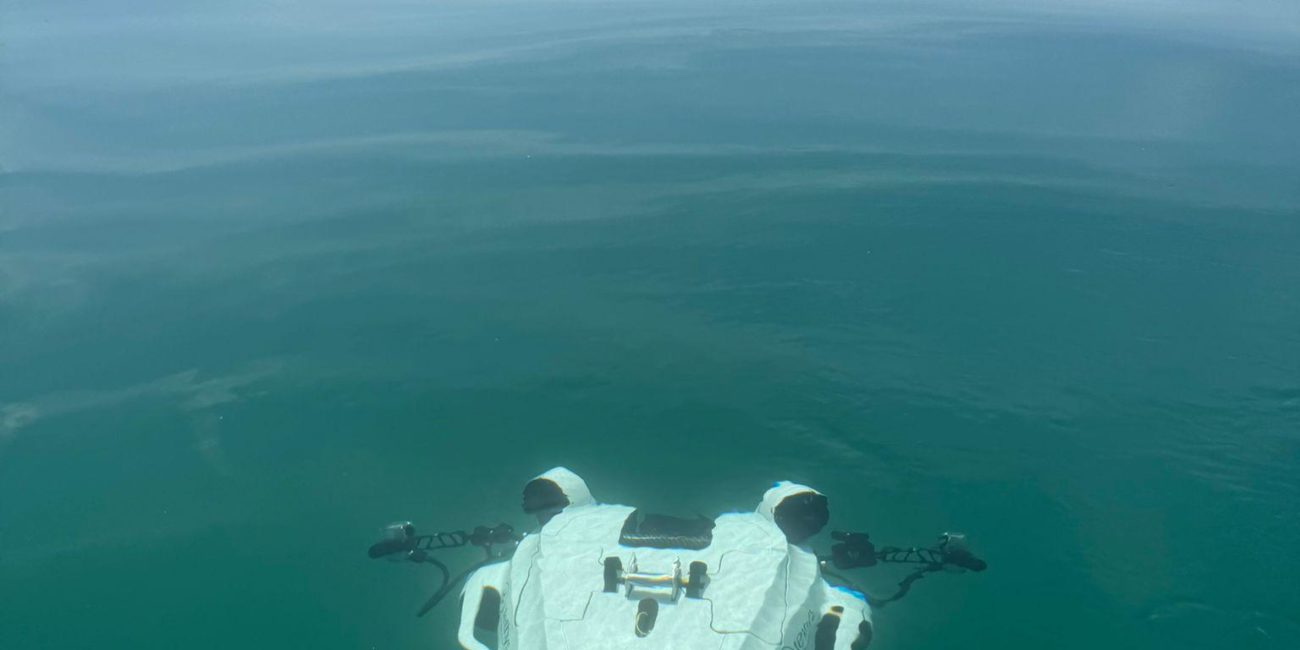
Tethys 4K Fusion is a lightweight multi-camera 4K payload for autonomous subsea 3D mapping. With real-time sensor fusion and closed-loop quality control, it enables digital twins, faster inspections, and superior data quality for offshore assets.
The Autonomous Systems Lab (ASL) at ETH Zurich is a leading robotics research group with core expertise in perception, mapping, and autonomous navigation in GPS-denied and complex environments. Their work spans aerial, ground, and underwater systems, with a strong focus on multi-sensor fusion, SLAM, and robust control. ASL has pioneered methods for real-time 3D reconstruction, digital twin generation, and multi-robot coordination, and has a strong track record in translating research into applications such as infrastructure inspection, disaster response, and energy systems.
Tethys Robotics is a Swiss ETH Zurich spin-off developing compact subsea robots that combine advanced autonomy, sensor-fusion, and modular payloads to automate underwater inspections. Its core product,Tethys ONE, enables high-resolution mapping, real-time 3D reconstruction, and digital twin generation of critical offshore and hydropower infrastructure. By reducing reliance on large vessels and human divers, the system improves safety, lowers costs, and significantly cuts emissions, offering a scalable solution for the energy transition and maritime safety.